
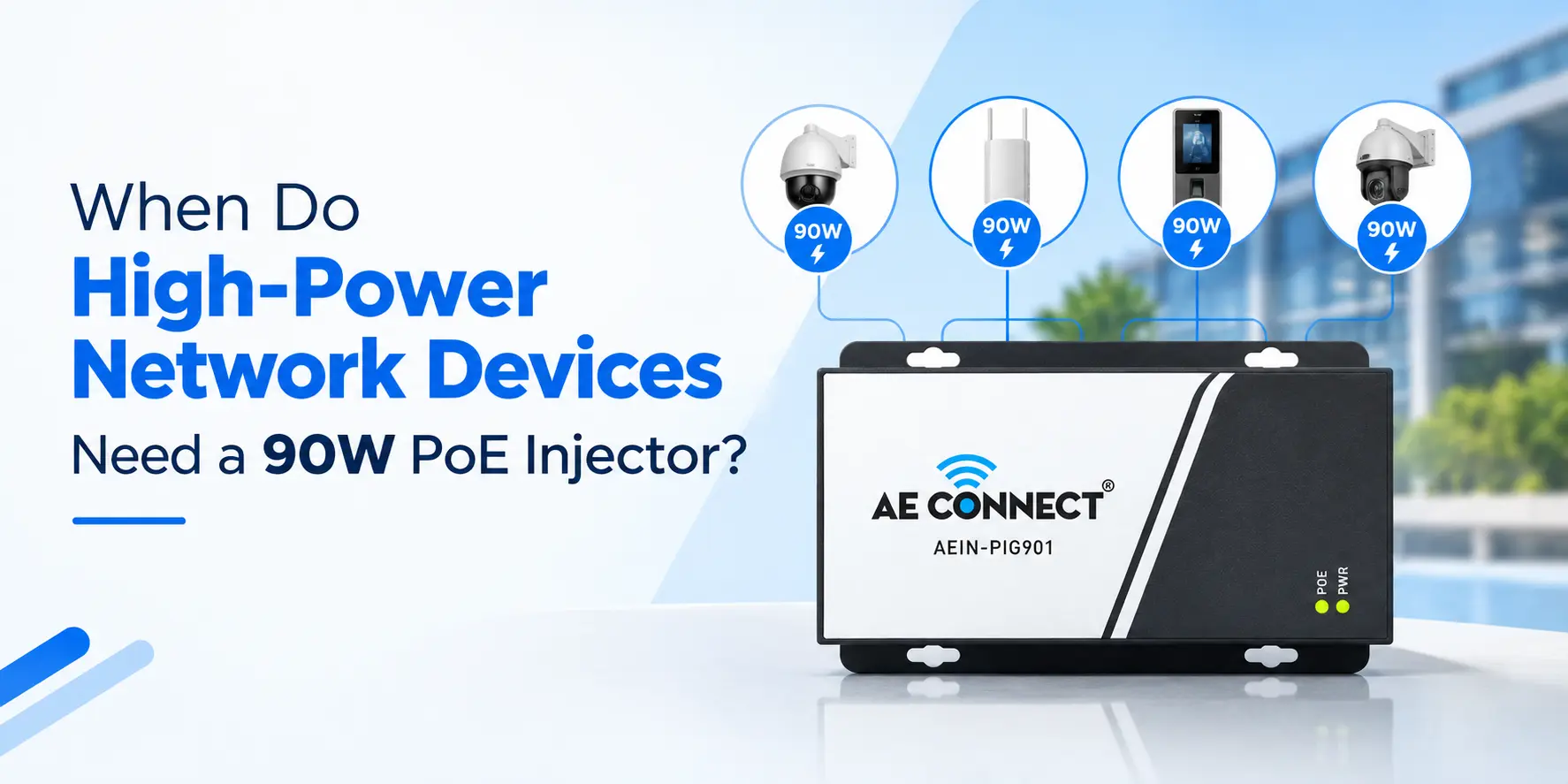
Network devices are becoming more capable, but increased functionality can also bring higher power requirements. Advanced surveillance cameras may include motors, heaters, or additional processing, while modern wireless access points and specialised IoT equipment can demand considerably more power than simpler network endpoints.
This creates an important question when designing a Power over Ethernet network: how much power does the connected device actually require?
A 90W PoE Injector is designed for applications where conventional lower-power PoE solutions may not provide sufficient capacity. By using PoE++ technology, a suitable injector can supply high-power compatible devices while carrying network data through the same cabling infrastructure.
However, choosing a 90W solution should be based on actual device requirements rather than assuming that more power is always better.
Why Power Requirements Are Increasing
Early PoE applications commonly involved devices such as basic IP phones and relatively simple network cameras. Today, network-connected devices can perform far more demanding tasks.
A modern endpoint may combine multiple functions within a single device. A surveillance camera, for example, might incorporate pan, tilt, and zoom mechanisms, while a high-performance wireless access point may contain multiple radios and support significantly greater network capacity.
This means network planners need to consider both connectivity and power during deployment.
Higher-power PoE can be relevant for equipment such as:
- Advanced PTZ and dome cameras
- IEEE 802.11ax wireless access points
- IP videophones
- Thin clients
- Compatible high-power IoT equipment
- Other PoE++ powered devices
AE Connect specifically identifies these types of applications for its AEIN-PIG901 90 Watt PoE++ Injector.
Understanding the Role of IEEE 802.3bt
Power over Ethernet standards help define how compatible power sourcing equipment and powered devices operate together.
For higher-power applications, IEEE 802.3bt extends PoE capability beyond earlier IEEE 802.3af and 802.3at implementations.
AE Connect’s AEIN-PIG901 complies with IEEE 802.3bt and maintains backward compatibility with IEEE 802.3af/at terminals. Its 90W power budget is delivered over four pairs.
This matters because high-power PoE is not simply a case of sending more electricity through the same connection without consideration for standards. The power sourcing equipment, powered device, and cabling infrastructure need to work together appropriately.
Checking the PoE standard supported by the endpoint should therefore be one of the first steps when planning an installation.
When Is 90W Capacity Actually Necessary?
Not every network device needs a high-power injector.
If an endpoint has relatively modest power requirements, selecting equipment solely because it offers a higher maximum output may provide no practical advantage.
A high-power solution becomes more relevant when the connected device requires power beyond what the lower PoE classes available in the planned installation can support.
Before selecting an injector, check:
The device’s PoE standard
Determine whether the powered device supports IEEE 802.3af, 802.3at, or 802.3bt.
Maximum power requirement
Review the manufacturer’s power specification rather than estimating requirements from the type of device alone.
Operating conditions
Some equipment can require different power levels when additional features are active.
Network connection
Confirm that the required data rate and physical network interface are supported.
Cable infrastructure
Use suitable cabling and follow the installation requirements specified for the equipment.
This assessment prevents both under-specification and unnecessary over-specification.
High-Power Surveillance Equipment
Surveillance is one of the clearest examples of why higher PoE capacity can be required.
A basic fixed IP camera and an advanced PTZ camera can have very different power requirements.
PTZ cameras incorporate motorised movement, and particular surveillance devices may include additional features that increase overall power consumption. In these situations, network designers should verify whether the available PoE source can support the camera under its required operating conditions.
AE Connect lists PTZ and dome cameras among the intended applications for the AEIN-PIG901.
Using a correctly matched injector allows power and Gigabit data connectivity to reach the compatible camera through the planned network connection without requiring the existing switch itself to provide PoE.
Supporting High-Performance Wireless Access Points
Wireless infrastructure has also evolved significantly.
Modern access points can support more users, additional radios, and higher network capacity than earlier generations. As capabilities increase, some access points can require higher PoE classes.
AE Connect identifies IEEE 802.11ax access points as one of the applications for its 90W model.
For network planners, the important consideration is not simply whether an access point supports PoE. The specific PoE standard and power requirement of that model should be checked.
This becomes particularly important when upgrading wireless equipment while retaining an existing non-PoE switch.
Instead of replacing an otherwise suitable switch, a compatible high-power injector can provide PoE capability to an individual endpoint.
Four-Pair Power Delivery
One technical distinction of higher-power PoE++ implementations is the use of all four cable pairs for power delivery.
AE Connect’s AEIN-PIG901 provides a 90W total power budget over four pairs.
The AEIN-PIG901-F similarly uses four-pair powering and supports IEEE 802.3bt Type 4, with up to 90W per port.
Using the appropriate standardised approach helps enable higher levels of power delivery while maintaining network data communication.
From an installation perspective, this makes cable quality and termination particularly important. Cabling should meet the requirements of the connected equipment and the intended network installation.
Adding High-Power PoE Without Replacing the Existing Switch
One practical situation for using an injector occurs when the existing network switch still meets the organisation’s data requirements but does not provide the required PoE output.
Consider an existing Gigabit non-PoE network where only one new high-power device needs to be installed.
Replacing the entire switch purely to power that endpoint may not always be necessary.
A compatible PoE++ injector can be installed between the network connection and the powered device, adding the required power to that individual link.
This targeted approach can be useful for:
- Adding a high-power surveillance camera
- Upgrading a particular wireless access point
- Installing a specialised PoE++ endpoint
- Expanding an existing non-PoE network incrementally
For a broader explanation of how injectors support network expansion, AE Connect’s Why PoE Injectors Are Essential for Expanding Modern Networks provides additional guidance on deployment and infrastructure planning.
AE Connect AEIN-PIG901 90 Watt PoE++ Injector
AE Connect’s AEIN-PIG901 is designed specifically for high-power Gigabit PoE applications.
Its key specifications include:
- 90W total power budget over four pairs
- IEEE 802.3bt PoE++ support
- Backward compatibility with IEEE 802.3af/at
- 1 × 10/100/1000M RJ45 PoE++ port
- 1 × 10/100/1000M RJ45 uplink port
- Up to 100 metres transmission range
- 6kV surge protection
- Dimensions of 182 × 76 × 44 mm
- Three-year warranty
AE Connect positions the model for equipment including 802.11ax access points, PTZ and dome cameras, IP videophones, thin clients and other high-power Ethernet terminals.
This makes the product particularly relevant when an existing network needs a dedicated high-power PoE connection without changing the complete switching infrastructure.
When Fibre Uplink Flexibility Is Required
Not every deployment relies exclusively on copper uplinks.
AE Connect also offers the AEIN-PIG901-F 90W BT Gigabit PoE++ Injector, which incorporates a blank SFP slot for fibre uplink integration.
The model supports IEEE 802.3bt Type 4 and is backward compatible with IEEE 802.3af/at. It provides up to 90W per port and a transmission range of up to 100 metres over Cat5e/6 cabling on the powered connection.
This creates another option for network designs where fibre connectivity forms part of the infrastructure.
The choice between an RJ45-uplink model and an SFP-equipped option should therefore be based on the network architecture rather than power capacity alone.
Why Backward Compatibility Matters
A network does not always consist of devices from a single PoE generation.
An organisation may have older IP cameras or phones alongside newer, higher-power endpoints.
Backward compatibility can therefore simplify infrastructure planning.
The AEIN-PIG901 supports IEEE 802.3bt while remaining backward compatible with IEEE 802.3af/at terminals.
This does not mean every connected device receives 90W. Power delivery depends on the compatible PoE equipment and its requirements.
Network planners should still verify device specifications before installation rather than relying solely on backward compatibility.
Consider Surge Protection in Network Planning
Power and data infrastructure can be exposed to electrical disturbances, making protection an important part of network design.
The AEIN-PIG901 includes 6kV surge protection.
The AEIN-PIG901-F specifies ±6kV surge immunity under EN 61000-4-5, together with ESD protection.
These specifications should be considered alongside the wider electrical and network protection strategy of the installation.
An injector’s built-in protection does not eliminate the need to properly design the overall system for its operating environment.
90W Injector or PoE++ Switch?
Another important decision is whether to use an individual injector or deploy a PoE++ switch.
An injector can make sense when:
- Only one or a small number of high-power devices need PoE
- The existing switch still meets network requirements
- Replacing the switch would add unnecessary infrastructure
- PoE capability needs to be introduced to a specific connection
A suitable PoE switch may be more appropriate when many powered devices need to be connected from a central location.
The decision should therefore consider the number of endpoints, total power requirement, management requirements, port capacity and future expansion plans.
This prevents the network from being designed around a single specification such as maximum wattage.
What to Check Before Selecting a 90W Model
Before deploying a high-power injector, network installers should verify the complete connection rather than focusing only on the 90W figure.
Check the following:
- Powered device requirement – Confirm its PoE standard and required power.
- Data rate – Make sure the injector supports the required network speed.
- Uplink type – Determine whether copper or fibre connectivity is required.
- Cable type and quality – Use cabling suitable for the installation and equipment.
- Distance – Check the supported transmission distance for the planned connection.
- Operating environment – Review temperature, mounting, and environmental requirements.
- Protection requirements – Consider surge and electrical protection as part of the complete installation.
A correctly matched system is more important than simply choosing the highest available output.
Conclusion
Higher-power network devices have changed what organisations need from Power over Ethernet infrastructure. Advanced surveillance cameras, modern wireless access points and specialised network endpoints may require more power than conventional PoE solutions can provide.
A 90W PoE Injector offers a practical way to introduce IEEE 802.3bt PoE++ power into an existing network without automatically replacing the current switch. AE Connect’s AEIN-PIG901 combines a 90W four-pair power budget with Gigabit connectivity, backward compatibility with IEEE 802.3af/at, a 100-metre range and 6kV surge protection.
The decision to use a 90W solution should ultimately begin with the powered device. By checking its standard, power requirement, network interface, cabling, and installation environment, businesses can select PoE infrastructure that matches the application rather than simply choosing more capacity than necessary.
Frequently Asked Questions
What is a 90W PoE Injector?
It is a high-power Power over Ethernet injector designed to add electrical power to a network connection for compatible powered devices. AE Connect’s AEIN-PIG901 supports IEEE 802.3bt PoE++ with a 90W power budget.
Which devices may require a 90W PoE injector?
Depending on their individual specifications, applications can include advanced PTZ cameras, 802.11ax wireless access points, IP videophones, thin clients and other compatible high-power Ethernet devices.
Does a 90W injector always send 90W to a connected device?
No. The injector’s 90W figure represents its supported power capacity. Actual power delivery depends on the compatible powered device and PoE negotiation. Device compatibility should always be checked.
Is IEEE 802.3bt backward compatible?
AE Connect’s AEIN-PIG901 supports IEEE 802.3bt and is specified as backward compatible with IEEE 802.3af/at powered devices.
How far can the AEIN-PIG901 transmit power and data?
AE Connect specifies a transmission range of up to 100 metres for the AEIN-PIG901. Installation conditions and suitable cabling should still be considered.
When should I use an injector instead of a PoE switch?
An injector can be practical when an existing switch meets the network’s data requirements but one or a small number of devices need PoE. For larger numbers of powered endpoints, a suitable PoE switch may provide a more centralised approach.