
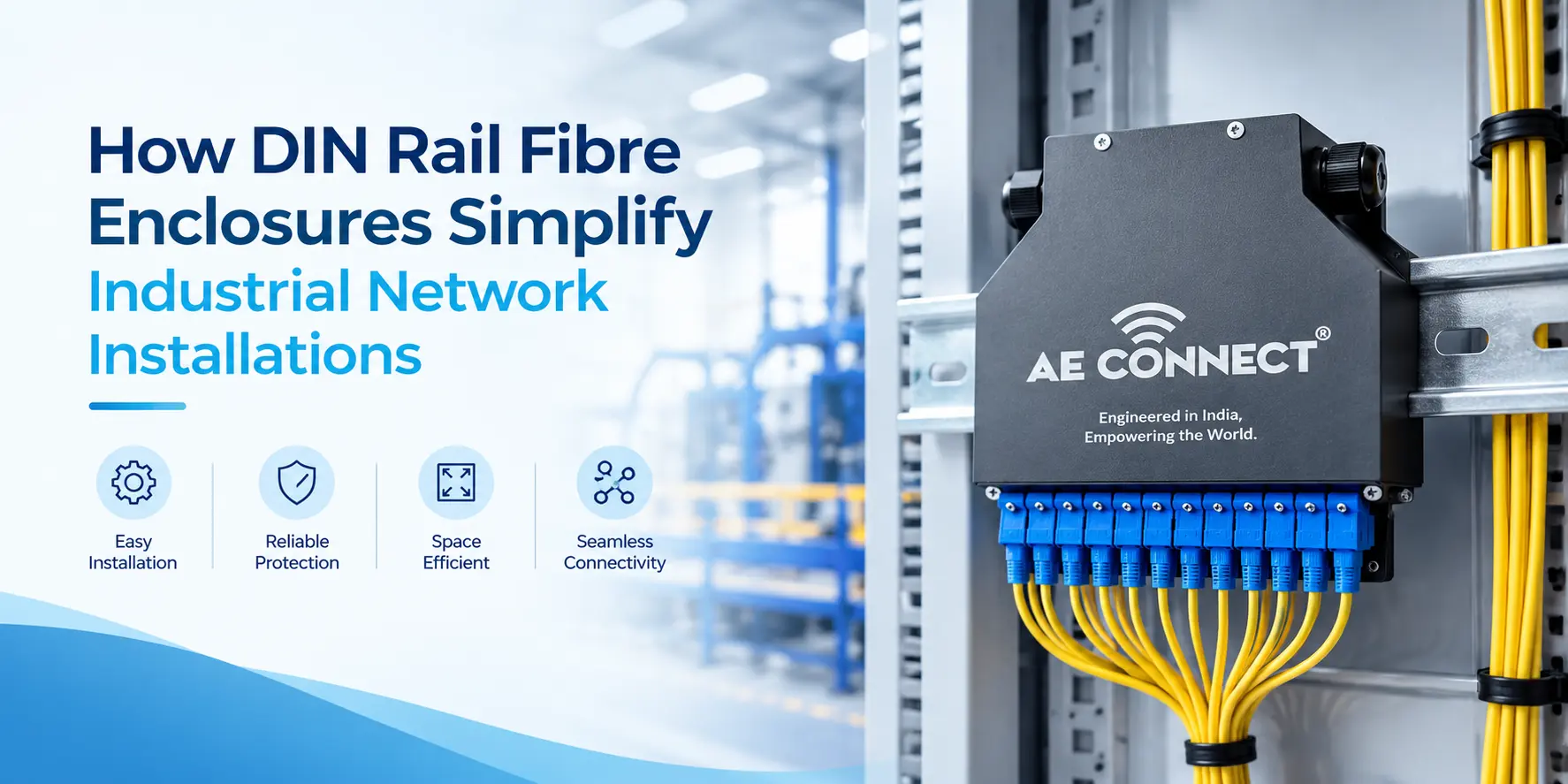
Industrial networks often need to fit sophisticated communication infrastructure into limited physical spaces. Control panels, automation cabinets and equipment enclosures may contain numerous electrical and networking components, leaving little room for conventional fibre termination equipment.
At the same time, fibre connections need proper routing, termination and organisation to remain accessible and protected. This creates a need for compact fibre management solutions designed specifically for constrained environments.
A DIN Rail LIU provides a practical approach by bringing fibre termination and organisation into a compact enclosure that can be mounted alongside other DIN-rail equipment. Instead of requiring a conventional rack-based installation, it can help network designers integrate fibre connectivity directly into control panels, cabinets, and industrial enclosures.
For industrial networks where available space and organised fibre management are important, this approach can simplify infrastructure planning.
What Is a DIN Rail LIU?
A DIN Rail Light Interface Unit is a compact fibre enclosure designed to organise, route and terminate optical fibre connections while mounting onto a DIN rail.
DIN rails are commonly used inside electrical and industrial control cabinets to mount compatible equipment in an organised arrangement.
Using the same mounting approach for fibre termination allows networking infrastructure to be incorporated into locations where installing a conventional rack-mounted fibre enclosure may be impractical.
AE Connect’s AE-FLIU-DINFL is designed specifically for space-constrained environments and can be installed in control panels, cabinets and enclosures.
The objective is not simply to reduce enclosure size. The fibre still needs to be properly routed, terminated and organised so technicians can access connections when required.
Why Industrial Networks Need Compact Fibre Management
Industrial network installations can differ considerably from conventional office networks.
A standard server room may provide dedicated racks with sufficient space for switches, patch panels and fibre termination equipment. Industrial environments, however, may require networking equipment to be distributed across multiple cabinets and control panels.
This can create several challenges:
- Limited installation space
- Multiple fibre connections
- Restricted access inside cabinets
- Need for organised cable routing
- Requirement for straightforward maintenance
- Integration with existing DIN-mounted equipment
- Protection of delicate fibre connections
Using a compact fibre termination enclosure allows designers to address these requirements without unnecessarily increasing the size of the installation.
Making Better Use of Limited Cabinet Space
Space efficiency is one of the main reasons to consider DIN-rail-mounted fibre equipment.
Industrial cabinets can contain power supplies, controllers, network switches, terminal blocks and numerous other components. Every additional device therefore needs to use the available space efficiently.
AE Connect describes its AE-FLIU-DINFL as a compact and rugged LIU designed for space-constrained environments.
Its DIN-rail mounting arrangement allows the fibre enclosure to become part of the cabinet layout rather than requiring a separate conventional rack.
This can be useful in locations such as control panels and other enclosed installations where space needs to be carefully planned.
Organising Fibre Connections More Effectively
Optical fibre is capable of supporting demanding network connections, but the physical fibre strands require appropriate handling.
Unorganised fibres can make identification, maintenance and future changes more difficult. A fibre termination enclosure provides a defined location for routing and organising these connections.
Within a planned industrial network, this makes it easier for technicians to identify where incoming fibres terminate and how those connections continue to other network equipment.
Good fibre organisation can also help simplify:
- Connection identification
- Maintenance
- Fibre routing
- Troubleshooting
- Network modifications
- Future expansion
The enclosure therefore becomes an important part of the physical fibre infrastructure rather than simply a mounting accessory.
Supporting Patch and Fusion Splice Termination
Different network projects can require different fibre termination methods.
AE Connect specifies that the AE-FLIU-DINFL supports patch or fusion splice field termination.
Fusion splicing creates a permanent connection between optical fibres by joining the fibres together. Patch-based connectivity, meanwhile, can provide a structured interface for connecting fibre equipment.
Having an enclosure capable of supporting fibre termination within a compact installation can be particularly useful when fibre needs to be brought directly into industrial control infrastructure.
The appropriate termination approach should always be selected according to the network design and installation requirements.
Flexible Connector Options
Connector requirements can vary between fibre networks.
A fibre enclosure that provides flexibility in adapter configuration can make it easier to adapt the physical termination point to project requirements.
The AE-FLIU-DINFL uses a replaceable panel for SC and LC type couplers, allowing the enclosure to accommodate different connection requirements.
AE Connect also states that the DIN mount can be extended up to 12 ports and can accommodate simplex and duplex connectors.
This flexibility can be useful when planning compact fibre installations with different port-density requirements.
Cable Entry and Fibre Routing
Good fibre management begins before the cable reaches the connector.
Installers need to consider where incoming fibre cables enter the enclosure, how they are routed internally, and how connections will remain accessible after installation.
The AE-FLIU-DINFL DIN mount supports a maximum of two cable entries, according to AE Connect’s product specifications.
Cable-entry planning is particularly important inside compact cabinets because poor routing can create unnecessary congestion.
Before installation, technicians should consider:
- Incoming fibre direction
- Cable entry points
- Fibre bend requirements
- Connector positions
- Splicing requirements
- Accessibility for future maintenance
Planning these elements before mounting the enclosure can result in a cleaner installation.
Durable Construction for Practical Installations
The enclosure material is another consideration when selecting fibre management equipment.
AE Connect’s AE-FLIU-DINFL uses a mild steel housing with powder coating. The company lists grey, white and black options, with customisation according to requirements.
A defined enclosure provides a dedicated physical space for fibre terminations and helps keep them separated from surrounding cabinet components.
However, the complete installation environment still needs to be considered.
The LIU should be selected and installed according to the environmental requirements of the specific project rather than assuming that enclosure construction alone makes it appropriate for every industrial condition.
Where Can DIN Rail Fibre Enclosures Be Used?
The compact mounting format makes this type of fibre enclosure particularly relevant where fibre connectivity needs to be integrated into cabinets or panels.
Industrial Control Panels
Automation systems may use fibre connections between different areas of a facility. A DIN-mounted enclosure can provide a structured termination point within the control cabinet.
Equipment Cabinets
Where rack space is unavailable, fibre termination may need to take place directly inside an equipment enclosure. Compact LIUs can help organise these connections.
Automation Networks
Industrial automation infrastructure often combines networking and control equipment within limited spaces. DIN-rail mounting can make it easier to integrate fibre management alongside compatible equipment.
Distributed Network Locations
Large facilities may contain network equipment across several locations rather than within a single central server room. Compact termination units can provide organised fibre endpoints at these distributed locations.
DIN Rail LIU vs Rack-Mounted LIU
DIN-rail and rack-mounted LIUs both provide fibre management functions, but their physical installation requirements differ.
A rack-mounted LIU is generally appropriate where dedicated networking racks are already available and larger fibre termination capacity is required.
A DIN-rail solution is more focused on compact environments where fibre termination needs to be integrated into a control panel or equipment cabinet.
The selection should therefore depend on factors such as:
Available space: Is there a network rack, or must the enclosure fit inside a cabinet?
Fibre count: How many connections need to be terminated?
Connector requirements: Which coupler and connector types are required?
Termination method: Will the installation use patching, fusion splicing or another suitable approach?
Expansion: Will additional fibre connections be required later?
Accessibility: Can technicians easily reach the enclosure for maintenance?
Rather than treating one format as universally better, network designers should select the enclosure according to the physical infrastructure.
Planning for Future Fibre Expansion
Even compact industrial networks can expand over time.
Additional machinery, surveillance equipment, automation controllers or remote network locations may create new connectivity requirements.
Planning fibre termination capacity in advance can therefore reduce unnecessary reworking later.
AE Connect states that its AE-FLIU-DINFL can be extended up to 12 ports.
However, port count is only one consideration.
Network planners should also evaluate available cabinet space, cable-entry capacity, fibre routing, connector types and accessibility before determining whether an enclosure will support expected future requirements.
Connecting DIN Rail LIUs with the Wider Fibre Network
A fibre termination unit does not operate independently. It forms part of a broader optical network.
Incoming fibre may terminate within the LIU before being connected to other network infrastructure through suitable fibre connections.
This means the complete design may involve components such as:
- Optical fibre cables
- Fibre adapters
- Fibre patch cords
- SFP modules
- Fibre switches
- Media converters
- Industrial network switches
Compatibility between these components is important when designing the complete connection.
This is also why fibre management should be considered during network planning rather than being treated as a final installation detail.
Installation Planning Matters
Selecting a suitable enclosure is only part of creating an organised fibre installation.
Before installing the unit, technicians should understand the fibre route, available cabinet space, required ports and future access requirements.
The location should allow the enclosure to be reached without unnecessarily disturbing neighbouring equipment.
Clear fibre identification and documentation can also make future maintenance easier.
A well-planned installation gives every fibre connection a defined termination point and reduces confusion when technicians need to inspect or modify the network.
Why Compact Fibre Management Matters for Industrial Networks
Industrial networking is increasingly dependent on reliable connections between equipment located across facilities, control systems and distributed network points.
As fibre connectivity becomes part of these environments, network designers need termination solutions that fit the physical infrastructure.
A compact DIN-mounted LIU provides a way to introduce organised fibre termination without depending on a full networking rack at every location.
This is particularly valuable where the network design needs to balance fibre organisation with restricted cabinet space.
Conclusion
Industrial fibre networks need more than fast connectivity. Their physical infrastructure must also be organised, accessible and appropriate for the available installation space.
A DIN Rail LIU provides a compact approach to routing, terminating and organising optical fibre connections inside control panels, cabinets and other space-constrained environments.
AE Connect’s AE-FLIU-DINFL combines DIN-rail mounting with replaceable SC/LC panels, support for patch or fusion splice field termination, a mild steel powder-coated enclosure and expansion up to 12 ports.
By considering fibre count, connector requirements, cable entry, termination method, available space, and future expansion, network planners can select a fibre enclosure that integrates more effectively into industrial infrastructure.
For a broader understanding of how Light Interface Units support fibre infrastructure, read AE Connect’s Essential Benefits of Installing an LIU Networking Device in IT Networks.
Frequently Asked Questions
What is a DIN Rail LIU?
A DIN Rail LIU is a compact Light Interface Unit designed for mounting on a DIN rail. It provides a structured location for routing, terminating and organising optical fibre connections in space-constrained installations.
Where is a DIN Rail LIU commonly installed?
It can be used in locations such as industrial control panels, equipment cabinets and other enclosures where a conventional rack-mounted fibre termination unit may not be practical.
What connectors does the AE-FLIU-DINFL support?
AE Connect specifies replaceable panels for SC and LC type couplers. The unit can also support simplex and duplex connector configurations.
Does the AE-FLIU-DINFL support fusion splicing?
Yes. AE Connect specifies patch or fusion splice field termination for the AE-FLIU-DINFL.
How many ports can the AE Connect DIN Rail LIU support?
According to AE Connect’s product information, the DIN mount can be extended up to 12 ports.
What is the difference between a DIN Rail LIU and a rack-mounted LIU?
The primary difference is the installation format. DIN-rail units are useful for compact cabinets and control panels, while rack-mounted LIUs are designed for rack-based network infrastructure and can be more appropriate where greater termination capacity is required.