
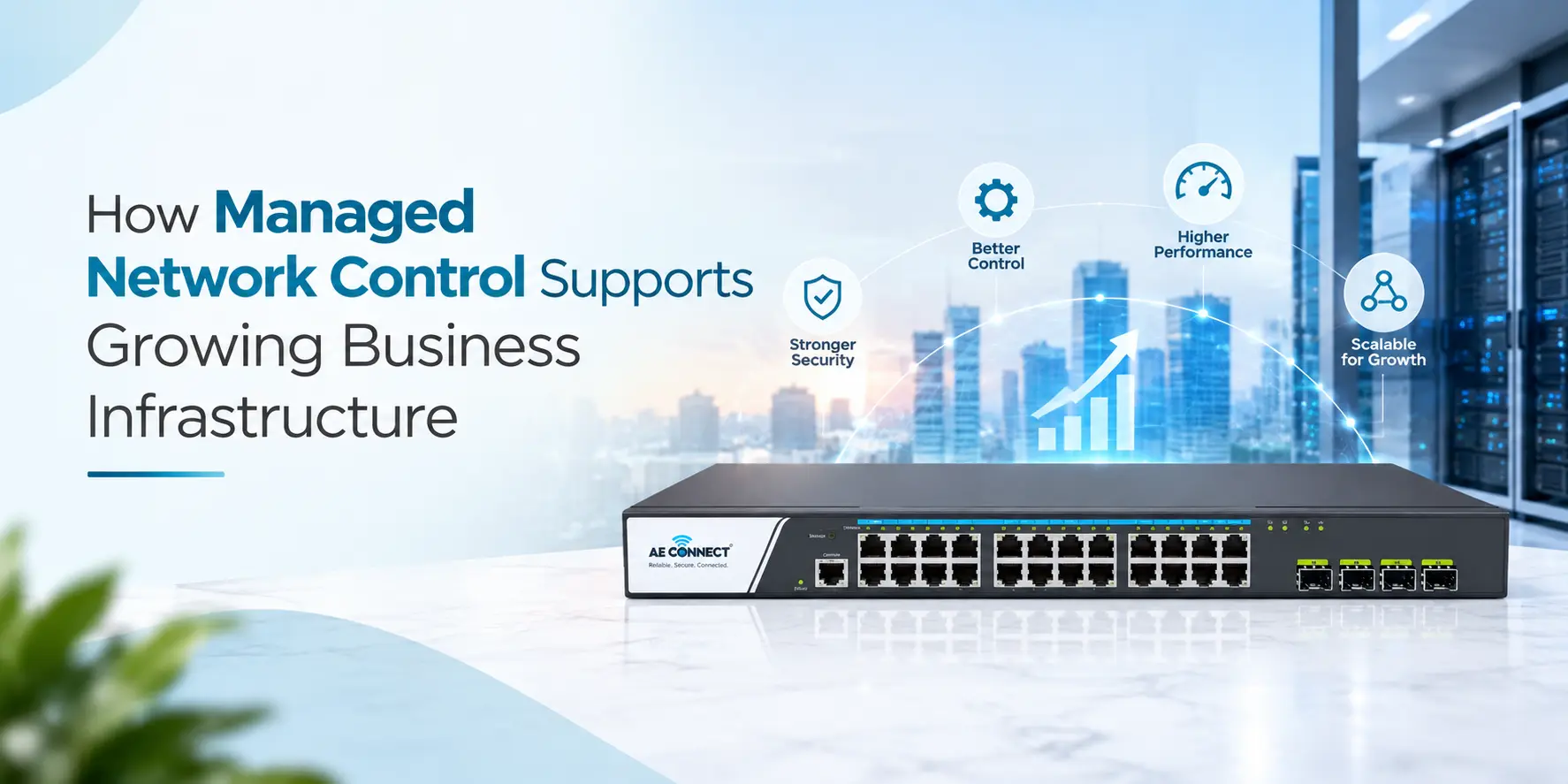
As business networks expand, simply connecting more devices is no longer enough. Organisations need greater visibility into how their networks operate, how traffic is prioritised, how devices are separated, and how network performance can be monitored.
IP cameras, wireless access points, VoIP phones and other connected devices can all share the same network infrastructure. As the number of endpoints increases, managing these connections efficiently becomes increasingly important.
A 24 Port Managed PoE Switch combines network connectivity and Power over Ethernet with management capabilities that give administrators greater control over the network. Rather than functioning only as a connection point, a managed switch can support traffic segmentation, monitoring, security policies, and network optimisation.
For growing organisations, these capabilities can provide a more structured approach to network expansion.
Why Growing Networks Need More Control
A small network with only a few connected devices may have relatively straightforward requirements. However, complexity increases as additional users, departments, and IP-based devices are introduced.
A growing network may include:
- IP surveillance cameras
- Wireless access points
- VoIP phones
- Network computers
- Access control equipment
- Other compatible PoE-powered devices
These devices may have different bandwidth, security, and performance requirements.
For example, surveillance traffic should not necessarily be treated in exactly the same way as ordinary office traffic. Similarly, voice communication may require different traffic priorities from general data transfers.
Managed networking provides administrators with tools for organising these different requirements more effectively.
Why 24 Ports Can Be Practical for Business Networks
Port capacity should always be selected according to the number of devices, expansion plans, and overall network design.
A 24-port configuration can provide a useful balance for business networks that have outgrown smaller switches but do not require a much larger port density.
It can provide connections for multiple network devices while allowing the organisation to centralise a significant portion of its network infrastructure.
Businesses should nevertheless avoid selecting a switch based only on the number of ports.
Important considerations include:
- Number of PoE devices
- Power requirements
- Required network speed
- Uplink requirements
- Management features
- Security requirements
- Future expansion
- Fibre connectivity
- Network architecture
Evaluating these factors together provides a better foundation for selecting suitable network equipment.
Power and Data Through a Common Infrastructure
One of the key benefits of a PoE network is the ability to transmit compatible power and data through network cabling.
This can simplify the installation of devices such as IP cameras, access points, and VoIP phones because separate electrical connections may not be required at every endpoint.
For larger deployments, however, businesses also need to consider the total PoE power budget.
Connecting 24 devices does not automatically mean that every connected device can draw its maximum required power simultaneously. The available power budget and the requirements of individual powered devices need to be evaluated during network planning.
This is particularly important when the network contains higher-power devices.
Network Segmentation with VLANs
As a network expands, keeping every device within a single network segment may not be desirable.
Virtual LANs, or VLANs, allow administrators to logically separate groups of devices even when they are connected through the same physical switching infrastructure.
For example, an organisation might create separate network segments for:
- Surveillance cameras
- Office users
- Voice communication
- Wireless devices
- Guest connectivity
This creates a more organised network structure and can help administrators apply different policies to different groups of devices.
AE Connect’s managed switch range includes VLAN functionality for network segmentation.
Prioritising Important Network Traffic
Not every type of network traffic has the same requirements.
A large file transfer, for example, may tolerate a short delay without causing a noticeable problem. Real-time voice or other latency-sensitive communication may be more affected by congestion.
Quality of Service, commonly referred to as QoS, provides mechanisms for prioritising selected traffic according to network requirements.
This can be useful in business environments where different applications share the same infrastructure.
Rather than allowing network congestion to affect all traffic equally, administrators can establish priorities according to the organisation’s requirements.
AE Connect’s AE-PS242SFT-M supports QoS functionality for traffic prioritisation.
Improving Network Visibility Through Monitoring
One of the significant differences between managed and unmanaged switches is visibility.
An unmanaged switch generally provides straightforward connectivity without the same level of configuration and monitoring.
Managed switches provide administrators with tools for observing and managing network behaviour.
For example, SNMP support can allow network administrators to monitor compatible network devices and collect information useful for infrastructure management.
AE Connect’s AE-PS242SFT-M supports SNMP V1, V2, and V3 along with system logs, CPU monitoring, memory monitoring, RMON, and other management functions.
This level of visibility can become increasingly valuable as the network expands.
Supporting Network Security
Network security is not limited to firewalls and endpoint software. Switching infrastructure can also contribute to how network access and traffic are controlled.
Managed switches can provide features that allow administrators to create more structured network policies.
AE Connect’s 24-port L2 managed model, for example, supports features including IP-MAC-Port Binding and Access Control Lists.
These tools can help administrators establish rules around network access and traffic.
However, a managed switch should form part of a broader security strategy rather than being treated as a complete security solution by itself.
Fibre Uplinks for Network Expansion
Copper network connections are commonly used for connecting endpoint devices, but fibre connectivity can become important when networks need to link different parts of a building, campus or wider infrastructure.
SFP uplinks provide flexibility for integrating fibre connections into the switching infrastructure.
AE Connect’s AE-PS242SFT-M 24 Port Gigabit L2 Managed PoE+ Switch provides four shared Gigabit RJ45/SFP slots alongside its 24 Gigabit PoE+ ports.
For organisations planning network expansion, uplink requirements should therefore be considered alongside endpoint port capacity.
This can be particularly important when connecting network racks, floors or other network segments.
L2 and L3 Managed Switching
Not every managed switch provides exactly the same capabilities.
Layer 2 managed switches focus primarily on switching functions within the local network and can provide capabilities such as VLANs, traffic management, and monitoring.
More advanced Layer 3 models can provide routing capabilities in addition to switching.
AE Connect currently offers both approaches within its 24-port managed PoE range.
The AE-PS242SFT-M is a Gigabit Layer 2 managed PoE+ switch, while the AE600-24GP4TF-L3 provides Layer 3 functionality for more advanced network environments.
The right choice depends on network architecture rather than assuming that the more advanced option is always necessary.
AE Connect AE-PS242SFT-M for Managed Network Infrastructure
The AE-PS242SFT-M is designed for networks that require Gigabit PoE connectivity combined with Layer 2 management.
Its core specifications include:
- 24 × 10/100/1000M self-adaptive PoE+ ports
- 4 × Gigabit RJ45/SFP shared slots
- 56Gbps backplane bandwidth
- 41.66Mpps packet forwarding rate
- 16K MAC address table
- 450W PoE power budget
- IEEE 802.3af and IEEE 802.3at PoE support
The switch also supports VLANs, QoS, SNMP, Access Control Lists, IP-MAC-Port Binding, multicast functions and multiple management methods.
These capabilities make it suitable for network environments where administrators require more control than an unmanaged switching solution provides.
When Should a Business Consider a Managed 24-Port Solution?
A managed switch becomes particularly relevant when the organisation needs to do more than simply connect devices.
Businesses may consider this type of network infrastructure when they need:
Multiple PoE Connections
Networks containing numerous cameras, access points, IP phones or other compatible powered devices may benefit from centralised PoE connectivity.
Network Segmentation
If different departments or device groups need logical separation, VLAN support becomes valuable.
Traffic Prioritisation
Networks supporting voice, surveillance and business applications may benefit from QoS capabilities.
Network Monitoring
Managed infrastructure provides greater visibility for administrators responsible for maintaining network performance.
Fibre Connectivity
SFP or SFP+ uplinks can support fibre connections where required by the network design.
Future Expansion
Selecting suitable port capacity, uplinks, and management capabilities can make it easier to accommodate additional network requirements later.
Avoid Choosing on Port Count Alone
A common mistake when selecting network switches is comparing models primarily by the number of available ports.
Twenty-four ports on one switch do not necessarily provide the same capabilities as 24 ports on another.
Businesses should compare:
PoE standard: Determine the power requirements of connected devices.
PoE budget: Calculate the combined power requirement rather than only counting endpoints.
Port speed: Check whether Gigabit connectivity is required.
Uplinks: Consider both uplink speed and whether fibre connectivity is needed.
Management: Determine whether VLAN, QoS, monitoring, and security controls are required.
Network layer: Decide whether Layer 2 management is sufficient or Layer 3 routing functionality is necessary.
Expansion: Consider how the infrastructure may change over the coming years.
This approach helps ensure that the switch fits the actual network rather than simply providing enough physical ports.
Building a Scalable Network
Scalability involves more than leaving a few unused ports.
A network designed for growth should consider bandwidth, power, management, uplink capacity, fibre connectivity and how different device groups will be organised.
A managed switch can provide the control required to adapt the network as requirements change.
For example, new VLANs can be introduced when additional departments or device categories are added. Traffic priorities can be adjusted as applications change, while monitoring tools can provide greater visibility as the infrastructure becomes more complex.
This flexibility is one reason managed switching becomes increasingly relevant as organisations move from simple networks towards larger business infrastructure.
Conclusion
As business networks expand, administrators need more than additional connection points. They need visibility, traffic control, segmentation, monitoring, and a network structure capable of adapting to future requirements.
A 24 Port Managed PoE Switch can bring these capabilities together by providing multiple PoE connections alongside configurable network management.
AE Connect’s managed PoE portfolio includes both Layer 2 and Layer 3 24-port solutions, allowing organisations to select an approach according to their network architecture and management requirements.
By evaluating power requirements, port capacity, uplinks, VLANs, QoS, monitoring, and future expansion together, businesses can build network infrastructure that is easier to control and better prepared for growth.
Frequently Asked Questions
What is a 24 Port Managed PoE Switch?
It is a network switch that combines multiple Ethernet connections, Power over Ethernet, and configurable network management. Depending on the model, management capabilities may include VLANs, QoS, SNMP, security controls, and traffic monitoring.
What devices can be connected to a managed PoE switch?
Compatible devices can include IP cameras, wireless access points, VoIP phones, and other PoE-powered network equipment. Device compatibility and power requirements should always be checked before deployment.
Why are VLANs useful in a business network?
VLANs allow administrators to logically separate different groups of devices or users. This can make network organisation and policy management more structured.
What is the purpose of QoS on a managed switch?
Quality of Service allows selected network traffic to be prioritised according to application requirements, which can be useful when multiple types of traffic share the same infrastructure.
Should I choose an L2 or L3 managed switch?
It depends on the network design. Layer 2 management can be sufficient for many access networks, while Layer 3 models are useful when routing and more advanced network functions are required.
Why should the PoE power budget be checked?
The power budget determines how much total PoE power the switch can provide. It should be compared with the combined power requirements of the connected devices rather than relying only on the number of available ports.