
Fiber Backbone Infrastructure
Fiber Backbone Infrastructure
That Goes the Distance
AE Connect supplies the complete fiber optic backbone for enterprise campuses, industrial plants, smart cities, data centers, and telecom networks - from OS2 single-mode cables and OM4 multimode patch cords to armoured outdoor fiber, fiber distribution frames, pre-terminated assemblies, and fiber media converters for every project scale.
20kmSingle-Mode Reach
10GBandwidth Ready
ZeroEMI Interference
ISOCertified Mfg.
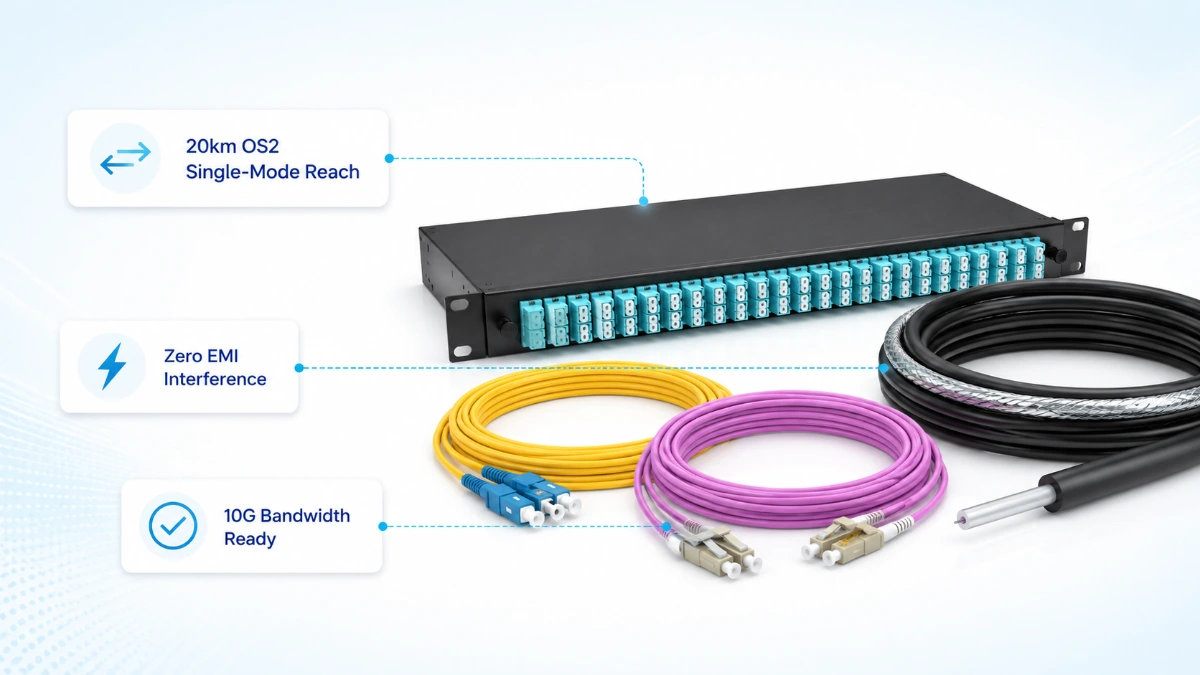
OS2 Single-Mode
OM4 Multimode
Armoured Outdoor
Why Fiber is the Backbone of Every Modern Network
Complete Fiber Optic Infrastructure for Every Project Type
Copper Ethernet stops at 100 meters. Fiber optic infrastructure breaks every distance and bandwidth barrier that copper imposes - carrying gigabit and 10-gigabit signals across campus buildings, industrial plant floors, city blocks, and entire geographic regions without signal degradation, electromagnetic interference, or the security vulnerabilities inherent to copper transmission.
AE Connect delivers the complete fiber optic backbone supply for system integrators, EPC contractors, telecom operators, and enterprise IT teams - single-mode OS2 and multimode OM3/OM4 cables in indoor, outdoor, and armoured variants, fiber distribution frames, high-density patch panels, pre-terminated assemblies for fast deployment, and fiber media converters that extend fiber to any existing copper switch port.
- OS2 single-mode fiber for inter-building and long-distance links up to 20 km+
- OM3 and OM4 multimode for intra-building and data center connections
- Steel wire armoured (SWA) outdoor fiber for direct burial and duct pulling
- Pre-terminated fiber assemblies for fast, error-free field installation
- Fiber distribution frames for organized, high-density central termination
- Fiber media converters to bridge copper switches to fiber backbone links
Fiber Infrastructure: Key Facts
Copper Stops at 100 Meters. Fiber Goes 20 Kilometers.
OS2 single-mode fiber eliminates every distance limitation that copper Ethernet imposes
100% EMI Immunity - No Copper, No Interference
Fiber carries light, not electricity. Motors, drives, and high-voltage lines have zero effect on fiber signal quality
OM4 Supports 10GbE Today, 40G and 100G Tomorrow
Fiber installed today handles future speed upgrades with only transceiver changes - no cable replacement needed
Fiber Cannot Be Tapped Without Physical Detection
Unlike copper, fiber tapping causes measurable signal loss - making it the only inherently secure physical layer medium
Made in India: Lower Cost, Faster Supply
Local manufacturing eliminates import delays and duties, with 200+ dealer supply points across India
Common Pain Points
Fiber Backbone Deployment Challenges
EPC contractors, system integrators, and network engineers regularly face these obstacles when planning and deploying fiber optic backbone infrastructure across enterprise, industrial, and urban environments.
Wrong Fiber Type for the Application
Specifying multimode fiber for runs that exceed its distance limits, or over-engineering with expensive single-mode where short-reach multimode is sufficient, are both common and costly mistakes. A project using the wrong fiber type requires complete cable replacement before it can support the intended speeds and distances, creating significant budget overruns.
Outdoor and Direct-Burial Installation
Standard indoor fiber cables are not rated for direct soil burial, aerial exposure, UV radiation, or rodent-prone environments. Deploying indoor-grade fiber in outdoor trenches or overhead conduit runs leads to rapid jacket degradation, moisture ingress, and fiber breaks within one to two monsoon seasons.
No Central Termination and Management
Fiber backbone projects without fiber distribution frames or organized patch panels result in unmanaged splices, unlabelled connections, and field-spliced joints scattered across cable routes. Future troubleshooting, adds-moves-changes, and fault isolation become extremely time-consuming and error-prone without centralized, structured fiber termination.
Slow Field Termination and Errors
Field-terminated fiber connectors require specialized fusion splicing or mechanical termination skills, proper test equipment, and considerable installation time per connector. Poor field termination quality causes high insertion loss, back-reflection, and unreliable link performance that is difficult to diagnose after installation is complete.
Extending Fiber to Existing Copper Switches
Many existing network deployments use copper switches without fiber SFP ports. Adding fiber backbone links to extend reach beyond 100 meters requires either complete switch replacement or dedicated media converters. Without the right converter hardware, integrating fiber backbone into existing infrastructure becomes a significant additional cost.
No Testing and Documentation
Fiber backbone installed without OTDR testing and insertion loss measurement leaves hidden faults - micro-bends, dirty connectors, and high-loss splices - that cause intermittent link failures. Projects without proper test records also have no baseline for future troubleshooting or warranty claims, making fault resolution time-intensive and expensive.
Our Approach
AE Connect Fiber Backbone System Design
AE Connect structures fiber backbone projects in four components - cable selection for each environment, organized central termination, pre-terminated assemblies for fast installation, and media converters for seamless integration with existing copper infrastructure.
Cable Selection
Right Fiber Type for Every Environment
AE Connect supplies the complete fiber cable range matched to each deployment environment - OM4 multimode for intra-building and data center links, OS2 single-mode for inter-building campus and long-distance runs, armoured SWA outdoor fiber for direct burial in trenches, UV-resistant aerial fiber for overhead pole runs, and LSZH indoor cable for plenum and raised-floor environments. Every project gets the fiber specification that fits the actual route, distance, and installation conditions.
Central Termination
Fiber Distribution Frames and Patch Panels
All backbone fiber routes terminate at organized fiber distribution frames (FDF) or high-density patch panels at each distribution point. Central termination gives every fiber connection a labelled, accessible port, makes cross-connects between backbone and equipment segments clean and repeatable, and provides the structured physical layer foundation that makes adds-moves-changes fast and fault isolation straightforward throughout the project lifecycle.
Fast Installation
Pre-Terminated Fiber Assemblies
Pre-terminated fiber assemblies arrive on site with factory-polished connectors at both ends, tested and certified to insertion loss specifications before shipment. Field installation becomes a pull-and-plug operation - no fusion splicing equipment, no on-site termination tools, no skill-dependent connector quality variation. Pre-terminated trunks dramatically reduce installation time and eliminate the most common source of fiber project rework.
Infrastructure Integration
Fiber Media Converters for Legacy Copper
AE Connect fiber media converters allow any existing copper Ethernet switch to connect to the fiber backbone without switch replacement. Single-fiber WDM BiDi converters reduce fiber strand consumption by carrying both transmit and receive on one fiber using different wavelengths. DIN rail industrial converters integrate directly into factory control panels. The result is fiber backbone reach at every network point regardless of what switch hardware already exists at that location.
The Complete Fiber Portfolio
Fiber Backbone Products by AE Connect
AE Connect supplies every component of a complete fiber backbone infrastructure project - cables, termination hardware, patch cords, and media converters - from a single source with unified quality, documentation, and technical support.
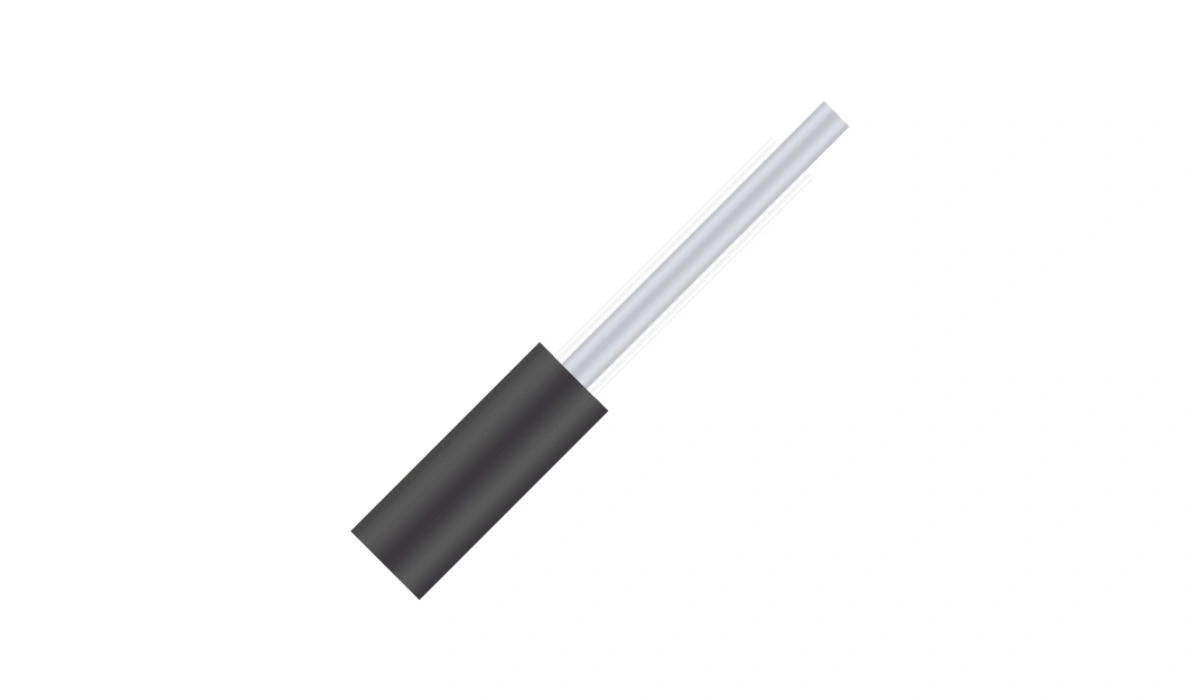
6-Core OS2 Single-Mode Outdoor Fiber Cable
AE-6CF-FRP-SM
High-performance G.652D single-mode fiber cable for long-distance campus and city backbone runs. FRP central strength member and PE outdoor jacket rated for duct, conduit, direct-burial, and OSP installations.
- G.652D single-mode, 6/12/24 core options
- Attenuation: 0.36 dB/km at 1310nm
- FRP strength member, PE black jacket
- Outdoor-rated for all OSP installation types
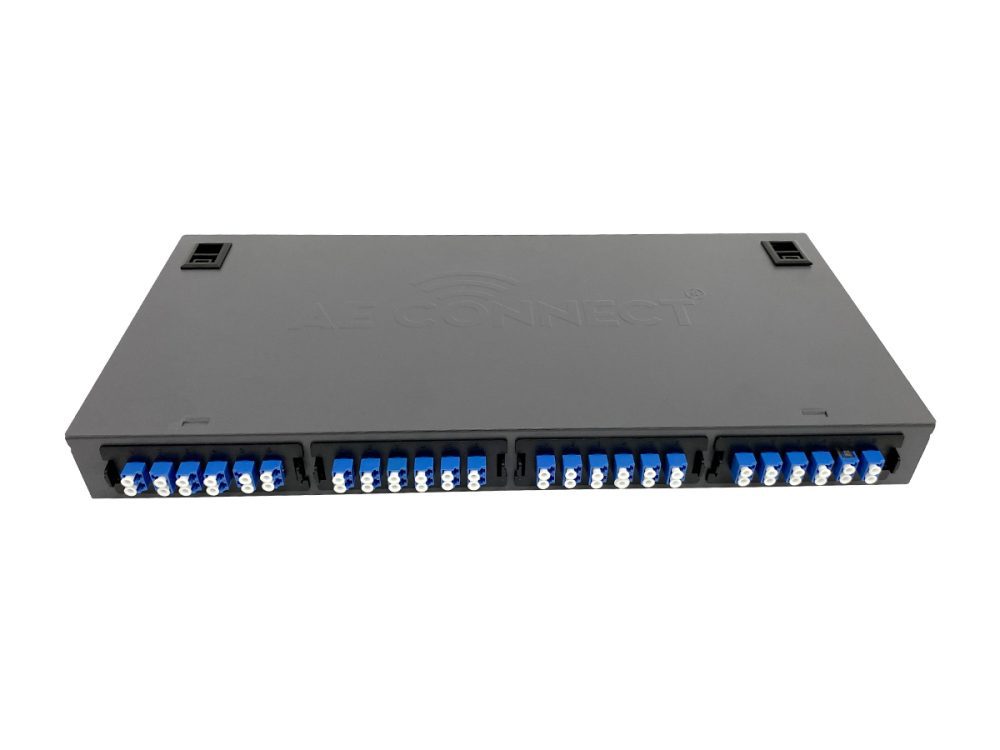
24-Port Fiber LIU (Termination Panel)
AE-24FLIU-ECO-UL
Compact 1U rack-mount fiber termination unit for organized splice and patch management at backbone aggregation points. SC/LC adapter panel with DIN rail mounting option for flexible site deployment.
- 24-port SC/LC panel, 1U rack or DIN rail
- Cold-rolled steel, powder-coated finish
- Operating temp: -40 to +60 degrees C
- TIA/EIA 568-C, ISO/IEC 11801 compliant

24-Port L3 Managed Fiber Switch
AE800-24GF8GC410GF-L3M
High-performance L3 fiber aggregation switch for backbone nodes. 24 GE SFP ports, 4x 10G uplinks, 128Gbps non-blocking bandwidth, and OSPF/RIP routing for enterprise-grade fiber backbone deployments.
- 24x GE SFP + 8x combo + 4x 10G SFP+
- 128Gbps backplane, 95.23Mpps forwarding
- L3: OSPF, RIP, Static routing, IPv6
- Dual power supply, ERPS ring protection

10-Port Unmanaged Fiber Switch
AE-FSG-3208
Cost-effective unmanaged fiber switch for small remote sites and distribution points. 8 SFP fiber ports plus 2 Gigabit copper uplinks deliver plug-and-play fiber connectivity with zero configuration overhead.
- 8x SFP fiber ports + 2x Gigabit copper
- Plug-and-play, zero configuration
- Supports SM and MM SFP modules
- Compact, fanless, silent operation

Cat 6A STP Patch Cord
AE-PP6ASFTP-GREY-0.4M
S/FTP shielded Cat 6A patch cord for connecting fiber switches to server and storage equipment at backbone aggregation points. Supports 10GBase-T with excellent alien crosstalk rejection.
- Cat 6A S/FTP shielded construction
- 10Gbps at full 100m reach
- Multiple lengths available
- TIA-568-C.2-1 and ISO 11801 certified
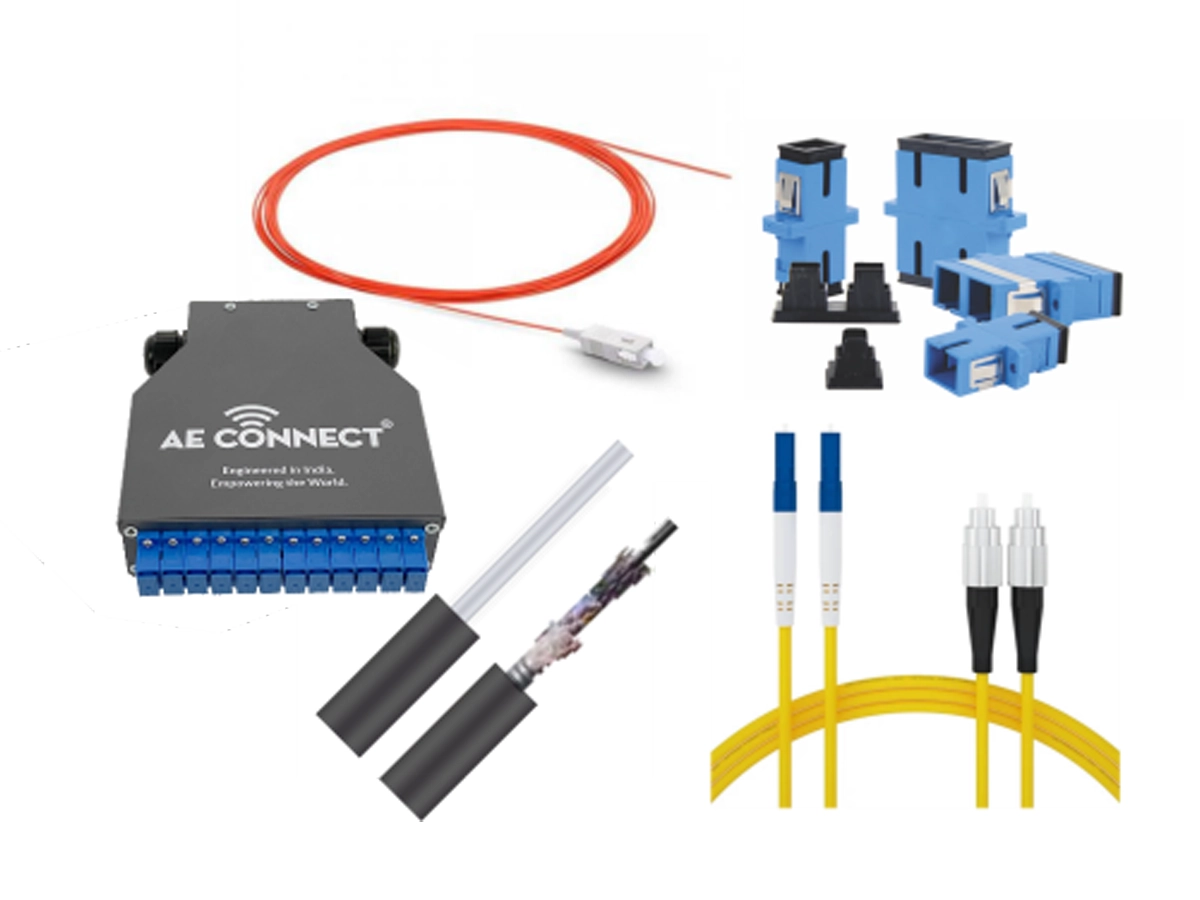
Fiber Passive Solutions
Pigtails, Splice Trays and LIUs
Complete passive fiber termination accessories including pigtails, splice trays, and distribution frames. Essential components for professional fiber backbone terminations at all aggregation and distribution points.
- SC/LC/ST pigtail options available
- Splice trays for organized fiber splicing
- LIU frames for rack and DIN rail mount
- Compatible with SM and MM fiber systems
Where We Deploy
Fiber Backbone Applications
AE Connect fiber infrastructure products are deployed by system integrators, EPC contractors, telecom operators, and enterprise IT teams across every environment where copper distance limits, EMI, or bandwidth demands make fiber the only viable solution.
Enterprise Campus Backbone
Inter-building fiber links connecting office towers, factory blocks, and campus buildings with gigabit and 10GbE backbone capacity.
Data Center Interconnect
OM4 intra-DC fiber for server-to-switch connections and OS2 inter-DC backbone for primary to disaster recovery site links.
Industrial Plant Backbone
EMI-immune fiber backbone connecting control rooms to field panels, SCADA nodes, and zone aggregation points across large industrial facilities.
Smart City Fiber Network
Underground armoured fiber connecting traffic nodes, CCTV poles, public Wi-Fi aggregation points, and the city command center.
Telecom and ISP Networks
Last-mile and metro fiber distribution networks, FTTH/FTTB deployments, and telecom backhaul infrastructure for ISPs and operators.
University and Campus Networks
Multi-building academic campus backbone linking hostels, labs, libraries, sports facilities, and admin blocks with a unified fiber ring.
Hospital Campus Infrastructure
Multi-block hospital campus fiber linking OPD, IPD, ICU, imaging, lab, and administrative buildings with redundant backbone connectivity.
Renewable Energy Projects
Armoured direct-burial fiber for solar farm SCADA networks, wind farm communication links, and remote substation monitoring systems.
The AE Connect Advantage
Key Benefits of AE Connect Fiber Infrastructure
AE Connect fiber backbone products deliver tangible performance, reliability, and project-lifecycle advantages over copper and over imported fiber alternatives on every deployment scale.
Unlimited Distance vs Copper
OS2 single-mode fiber carries 10GbE signals up to 10 kilometers and 1GbE beyond 80 kilometers per link without repeaters or amplifiers - eliminating every distance constraint that copper Ethernet imposes and making fiber the only practical choice for campus and city-scale backbone deployments.
Complete EMI Immunity
Fiber transmits light, not electrical signals. Industrial machinery, variable frequency drives, power transformers, lightning, and utility grid interference have zero effect on fiber signal integrity - eliminating the packet errors and link dropouts that copper cabling experiences in every industrial and outdoor installation environment.
Future-Proof for Higher Speeds
OM4 multimode and OS2 single-mode fiber installed today supports 10GbE, 25GbE, 40GbE, and 100GbE with only SFP transceiver changes at each end - no cable replacement needed. The physical fiber infrastructure serves the project for 20 to 25 years regardless of how bandwidth requirements grow.
Inherently Secure Transmission
Tapping a fiber cable requires physically cutting or bending the cable in a way that causes measurable optical loss - immediately detectable with OTDR monitoring. Unlike copper, fiber cannot be passively intercepted without detection, making it the preferred physical medium for secure communications infrastructure in government, defence, and financial applications.
Pre-Terminated Speed of Deployment
Pre-terminated AE Connect fiber trunk assemblies reduce field installation time for backbone links from hours to minutes per run. Factory-certified insertion loss eliminates the most common cause of field rework - poor quality field terminations - and provides a tested, documented baseline for every fiber link in the project from day one.
Complete Supply, Single Source
AE Connect supplies cables, FDF frames, patch panels, patch cords, pre-terminated assemblies, and media converters from a single vendor - simplifying procurement, unifying warranty management, and giving project engineers one technical point of contact for the entire fiber backbone infrastructure from cable to termination.
Our Credentials
Why Integrators Specify AE Connect Fiber
Made in India, Consistent Supply
AE Connect fiber products are manufactured and sourced from India, providing consistent local availability without import dependency or currency risk. Large-volume fiber projects get priority scheduling directly from our Ahmedabad facility with no minimum import lead times.
ISO-Certified Quality for Project Compliance
ISO quality management certification ensures every fiber cable, patch cord, and FDF unit shipped for your project meets consistent quality standards. ISO documentation supports government project quality audits, client acceptance testing, and enterprise procurement compliance requirements.
200-Plus Dealers for Fast Regional Supply
Our 200+ authorized dealers across India maintain local fiber cable stock in major cities and industrial regions. Site-critical shortages during active installation phases are resolved through local pickup rather than waiting for factory dispatch, keeping your project on schedule.
Custom Cable Specifications Available
Non-standard core counts, special jacket materials for chemical resistance or extreme temperature, custom pre-terminated lengths, and project-specific labelling are all available from our in-house capability. Large project custom requirements are handled without third-party sourcing delays.
Complete Project and Tender Documentation
Product datasheets with optical specifications, ISO certificates, LSZH compliance declarations, company profile, and BoQ templates for government tender submissions - all available from AE Connect to support integrators preparing fiber project bids and client technical proposals.
AE Connect at a Glance
Established in 200520+ years supplying fiber and networking products to Indian projects
Operations in Ahmedabad, GujaratDirect factory supply and quality control under ISO-certified management
200+ Authorized Dealers Pan-IndiaRegional stock availability near every active fiber project site
ISO-Certified Quality ManagementInternational quality standards for government and enterprise compliance
Products Deployed InternationallyAE Connect fiber and networking products in use across global markets
Full Technical and Tender DocumentationOptical specs, compliance certs, and BoQ templates for project submissions
Project Types We Supply
Industries and Projects We Serve
AE Connect fiber backbone products are deployed across every major industry and infrastructure category where distance, bandwidth, security, or electromagnetic environment makes fiber the required transmission medium.
Enterprise Campuses
Data Centers
Industrial Plants
Smart City Projects
Telecom and ISPs
University Campuses
Hospital Campuses
Government Projects
Power and Utilities
Rail and Transit
Renewable Energy
Defence and Security
End-to-End Support
End-to-End Fiber Project Support
Technical and commercial support at every stage of your fiber backbone project - from cable type selection and route planning through product supply, on-site technical guidance, and post-installation warranty service.
Fiber Type and Route Design
Fiber type selection by link distance and application, cable type selection by installation environment, core count planning, FDF sizing, and route-specific BoQ - all provided by our technical team for qualified projects.
Project BoQ and Tender Docs
Complete BoQ with optical specifications, ISO certificates, LSZH declarations, and company profile formatted for government and enterprise tender submissions and client technical proposals.
Volume and Phased Delivery
Large-volume fiber cable orders dispatched directly from factory with phased delivery aligned to installation phases. Local dealer pickup available in major cities for emergency site requirements during active projects.
Warranty and After-Sales
Product warranty on all AE Connect fiber products. Defective product replacement through our national dealer network. Technical support for optical performance issues from our pre-sales engineering team.
Start Your Fiber Project
Build Your Fiber Backbone with AE Connect
Share your project scope, distances, and installation environment with our fiber team. We will recommend the right cable types, core counts, termination hardware, and pre-terminated assemblies - and provide a complete project BoQ ready for procurement or tender submission.
Frequently Asked Questions
Frequently Asked Questions
When should I use single-mode OS2 fiber versus multimode OM3 or OM4?
The choice between single-mode and multimode fiber depends on the distance of each link and the budget available for transceivers:
- OM3 multimode: Use for links up to 300 meters at 10GbE or up to 100 meters at 40GbE. Lowest cost transceivers (850nm VCSEL). Best for intra-building and short campus links in smaller deployments
- OM4 multimode: Use for links up to 400 meters at 10GbE or 150 meters at 40GbE. Slightly higher cable cost than OM3 but recommended for all new installations to maximize headroom for future speed upgrades. Best for data center intra-DC and medium campus runs
- OS2 single-mode: Use for any link exceeding 400 meters, or whenever future-proofing for very high speeds is a priority. OS2 supports 10GbE to 10 km and 100GbE to 2 km on the same fiber. Transceiver cost is higher than multimode but cable cost per meter is comparable. Mandatory for inter-building campus runs, city fiber networks, and inter-site data center links
What type of outdoor fiber cable should I use for direct burial underground?
Direct burial fiber cable requires specific construction features to survive in-ground installation without conduit protection. The key requirements are:
- Steel wire armour (SWA): A layer of galvanized steel wires around the cable provides crush resistance against rocks in the trench, protection from digging equipment during future excavation near the route, and rodent bite resistance
- Gel-filled moisture blocking: Flooding gel between the cable's loose tube elements and inner jacket prevents water ingress along the cable length if the outer jacket is punctured or at connector entry points
- UV-resistant outer jacket: HDPE or PE outer jacket rated for UV exposure at any above-ground sections of the route, such as entry and exit points from underground conduit
- Temperature rating: Outdoor burial cables must be rated for the full temperature range of the installation region - typically -20 to +70 degrees C for Indian climate conditions
What are the advantages of pre-terminated fiber assemblies over field termination?
Pre-terminated fiber assemblies offer significant advantages over field termination in most project scenarios:
- Quality consistency: Factory polished connectors achieve insertion loss of 0.1 to 0.3 dB per connector - field connectors from even skilled technicians typically average 0.3 to 0.5 dB with more variation between connectors on the same link
- Installation speed: Pulling and plugging a pre-terminated trunk takes minutes per run. Field termination of the same link takes 20 to 60 minutes per connector depending on method and technician skill
- No specialized tools on site: Field termination requires fusion splicer, cleaver, OTDR, insertion loss meter, and connector supplies. Pre-terminated assemblies require none of this equipment on site
- Tested and certified: Each assembly is insertion-loss tested at the factory and shipped with a test report. Field installations have no test records unless separately tested after completion
- Predictable project scheduling: Pre-terminated assemblies have fixed factory lead times and installation rates. Field termination speed varies with technician availability and skill level
How do fiber media converters work and when should I use them?
A fiber media converter is a device that converts standard copper Ethernet signals (RJ45) to optical fiber signals (LC or SC fiber connector) at one end of a link, allowing a copper-only switch to connect to a fiber backbone run. At the other end of the fiber link, a second media converter converts back from fiber to copper for the next switch or device. Media converters are used when:
- A network switch does not have SFP fiber ports, and replacing it is not justified by the project budget
- A link must exceed 100 meters but the switch on one or both ends is copper-only
- Adding fiber uplink capability to an existing access switch in a building that is being connected to a new campus fiber backbone without replacing all access hardware
- Connecting fiber between two locations that are in different electrical ground potential zones - fiber provides galvanic isolation that prevents ground loop interference between buildings
How many fiber cores do I need for a campus backbone project?
Fiber core count planning should account for current active links, future expansion, and spare capacity for maintenance. The standard planning approach is:
- Active links: Each active fiber link requires 2 cores - one for transmit and one for receive. An aggregation point with 10 uplinks and downlinks requires 20 cores minimum for current traffic
- Future expansion: Plan for 50 to 100% more cores than currently required. If you need 20 active cores today, specify 36 to 48-core cable. Adding fiber cores after installation requires trenching and new cable pulls - far more expensive than installing larger core count cable during initial construction
- Maintenance spares: Reserve at least 10 to 20% of total cores as dedicated spare capacity for replacing damaged or degraded fibers without affecting live traffic during maintenance operations
- WDM upgrade path: If planning for future wavelength-division multiplexing to multiply bandwidth on existing fiber strands, single-mode OS2 fiber enables this - multimode does not support WDM
Can AE Connect supply complete fiber backbone infrastructure for large EPC and infrastructure projects?
Yes. AE Connect provides complete end-to-end fiber backbone infrastructure supply for projects of any scale, from single-building riser cabling to multi-kilometer city fiber networks. Our supply scope covers OS2 single-mode fiber cables in indoor, outdoor, and armoured variants for all environments and distances, OM3 and OM4 multimode fiber cables for intra-building and data center applications, steel wire armoured outdoor fiber for direct burial and aerial installation, pre-terminated fiber trunk assemblies in custom lengths and connector configurations, fiber distribution frames in wall-mount and rack-mount configurations from 12 to 96 ports, high-density 1U and 2U rack-mount fiber patch panels, OM3/OM4 and OS2 fiber patch cords in all standard connector types and lengths, WDM BiDi and standard fiber media converters for copper-to-fiber integration, and passive fiber accessories including splice closures, cable management trays, and connector adapter plates. For large EPC and infrastructure projects we provide fiber type selection by link, route-level core count planning, BoQ preparation, ISO documentation for tender compliance, phased delivery scheduling against construction milestones, and volume pricing for registered system integrators and EPC contractors. Contact our fiber team with your project scope and route layout to receive a complete product recommendation and project quotation.