
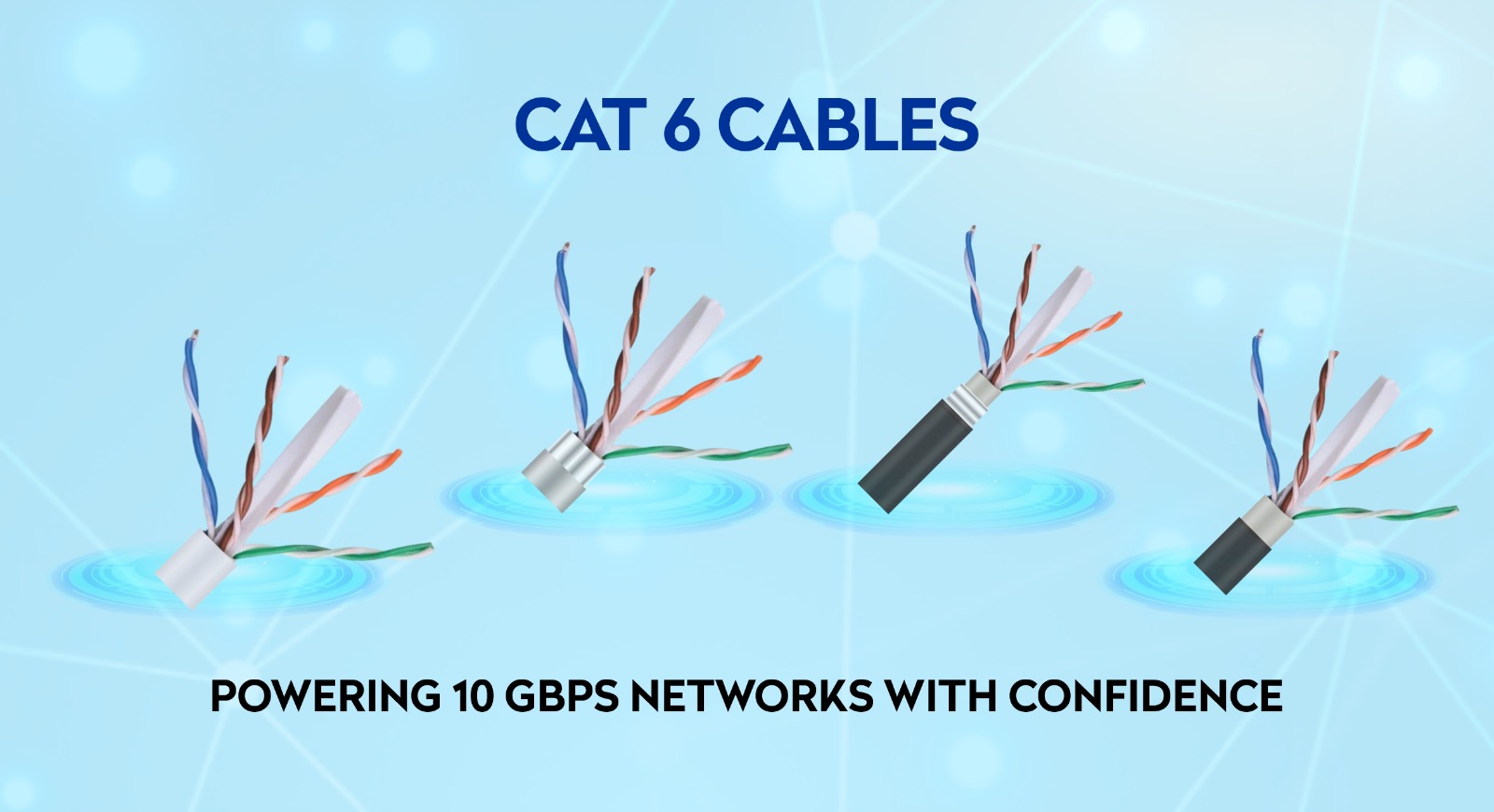
Are you planning a networking infrastructure upgrade and finding yourself tangled in acronyms? If the goal is lightning-fast speed and rock-solid reliability, you’ve undoubtedly heard of Cat 6 Cable. But what makes this standardized twisted-pair Ethernet network cable the default choice for modern connectivity?
In this detailed guide, we will unpack the specifics of the Category 6 cable, explore its superior benefits and diverse applications, and give you the essential criteria for choosing the right one to future-proof your network.
What Elevates Category 6 Above the Rest?
A Cat 6 Cable is a standardized cable designed to support high-speed Ethernet networks. Its core advantage lies in its ability to support data transmission speeds of up to Gigabits per second (10 Gbps) over short distances (up to 55 meters) and consistent 1 Gbps performance over its full 100-meter run.
The key technical differences that set the Category 6 cable apart from its predecessors (like Cat5e) include:
- Higher Frequency Support: Cat 6 is certified to handle frequencies up to 250 MHz, more than double the 100 MHz of Cat5e. This wider bandwidth allows it to process more data simultaneously, leading to faster and more consistent speeds.
- Reduced Crosstalk: Internally, Cat 6 features a tighter winding of its twisted pairs and often includes an internal spline (or separator) to keep the pairs isolated. This physical structure minimizes “crosstalk” (signal interference between adjacent wires), which is critical for maintaining high-speed data integrity.
- Shielding Options: While Cat5e typically comes unshielded, Cat 6 offers more robust shielding (e.g., foil or braid) options to combat electromagnetic interference (EMI) in electrically noisy environments.
At AE Connect, we recognize that the performance of a Category 6 cable hinges entirely on its construction. That’s why our cables are rigorously tested and certified to consistently meet or exceed the 250 MHz frequency standard, ensuring maximum bandwidth delivery and minimal crosstalk attenuation for your demanding applications.
Benefits of Choosing High-Performance Network Cable
Upgrading your infrastructure to Cat 6 Cable delivers several immediate and long-term benefits:
| Benefit | Description | Real-World Impact |
| Superior Speed | Supports speeds up to 10 Gbps (short runs) and reliable 1 Gbps across 100 meters. | Eliminates network bottlenecks during large file transfers, cloud backups, and video conferencing. |
| Enhanced Reliability | Tighter twisting and better shielding dramatically reduce signal interference and data errors. | Ensures stable connections for critical systems, reducing frustration for gamers and streamers alike. |
| Future-Proofing | Provides the necessary bandwidth foundation for advanced technologies like 4K/8K video, VoIP, and IoT systems. | Prevents costly network overhauls as your business or home technology evolves. |
| Longer Runs | Maintains higher speeds over longer distances compared to Cat5e, useful for large offices or campus networks. | Simplifies installation layouts across extensive properties. |
Versatile Applications for Category 6 Cable
The dependability and speed of a Cat 6 Cable make it the go-to solution for almost any demanding connection:
- Enterprise and Data Centers: Used for backbone wiring between switches, servers, and storage arrays where 1 Gbps or 10 Gbps links are standard.
- Home Networks & Gaming: Provides the lowest possible latency for competitive gaming and ensures maximum speed for 4K media streaming to smart TVs and home theaters.
- PoE Systems: Delivers both data and power to high-demand devices like advanced security cameras and high-density Wireless Access Points (WAPs).
- Smart Buildings and IoT: Serves as the stable backbone for connecting lighting controls, environmental sensors, and building management systems.
Choosing the Right Cat 6 Cable
Selecting the right Category 6 cable means going beyond simply checking the “Cat 6” label. You must consider the environment and specific performance needs.
- Shielding (UTP vs. STP):
- UTP (Unshielded Twisted Pair): Cost-effective, commonly used in quiet office environments.
- STP (Shielded Twisted Pair): Recommended for noisy industrial environments or areas near machinery, offering maximum protection from EMI.
- Jacket Rating (Plenum vs. Riser):
- Plenum: Required for spaces used to circulate air (e.g., above suspended ceilings) due to its low-smoke, non-toxic properties in case of fire.
- Riser: Used for vertical runs between floors.
- Construction (Solid vs. Stranded):
- Solid: Best for permanent, long-distance in-wall installations (better signal performance).
- Stranded: Best for short patch cables and connections that require frequent bending and flexibility (like connecting a PC to a wall jack).
AE Connect: Your Partner in High-Performance Networking
Choosing the right network infrastructure component is an investment in stability and speed. By selecting a high-quality Category 6 cable, you ensure your network can handle today’s 4K streaming and tomorrow’s bandwidth demands. For this critical foundation, trust is key. AE Connect, an Indian manufacturer with over two decades of experience since its humble beginnings in 2005, specializes in delivering high-performing and reliable networking solutions.
Our mission is to simplify your data and video networking experience through quality, affordable, and easy-to-understand products. Choose AE Connect‘s rigorously tested Cat 6 Cables to build a secure, fast, and future-proof connection that you can rely on.
Frequently Asked Questions (FAQ)
What is the difference between Cat 6 vs Cat 5e cable?
The main difference is bandwidth: Cat 5e supports up to 100 MHz and 1 Gbps, while Cat 6 cable supports up to 250 MHz and can handle 10 Gbps over short distances, offering superior crosstalk performance.
Can Cat 6 Cable support 10 Gbps speed?
Yes, Cat 6 Cable can support speeds up to 10 Gbps, but only over a maximum run length of 55 meters (180 feet). Beyond this distance, performance typically reverts to 1 Gbps.
How does shielding improve cable performance?
Shielding (like foil or braid) prevents external electromagnetic interference (EMI) from disrupting the data signals within the twisted pairs. This is essential for maintaining signal integrity and high speed in environments with motors, fluorescent lighting, or heavy machinery.
What is the maximum distance for a Cat 6 Cable run?
The maximum standard distance for a 1 Gbps connection using a Cat 6 Cable is 100 meters (328 feet). For 10 Gbps speeds, the maximum distance is reduced to 55 meters.
Should I choose a solid or stranded Cat 6 Cable?
You should choose a solid Cat 6 cable for permanent, fixed installations (e.g., in walls or conduits). You should choose a stranded cable for flexible patch cords that move frequently (e.g., connecting a computer to the wall).